

The future of ethical, inclusive, and human-centered technology is being shaped now.
Digital Humanism is an emerging interdisciplinary movement examining the complex relationship between technology and humanity, with the goal of ensuring that technology is designed and used in ethical, inclusive, and society-benefiting ways.
Building on the success of earlier ACM Digital Humanism Summer Schools in Vienna, and the First African Digital Humanism Summer School in Kigali, Rwanda, the Second African Digital Humanism Summer School will take place from Monday August 31 to Saturday, September 05, 2026, at the Central University, Christ Temple Campus, Abossey Okine, Accra, Ghana.
https://maps.app.goo.gl/fAbd3G4oQr4qvEmS8
The bootcamp on Saturday 5 September, will be held at UPSA – University for Professional Studies, Accra.
Hosted under the Digital Humanism initiative, this international Summer School brings together researchers, PhD students, innovators, policymakers, technologists, and social scientists to explore how digital technologies and AI can better serve humanity — especially within African contexts.
Carnegie Mellon University Africa, together with the W4RA Research Program, will undertake the organization of the Digital Humanism Innovation Bootcamp. This will be an integral part of the Summer School.
The bootcamp description in pdf by CMU-Africa can be downloaded here.
The bootcamp use cases syllabus by the W4RA research group can be downloaded here.
Participants will engage with globally recognized experts in:
- Artificial Intelligence & Society
- Digital Ethics & Governance
- Technology Policy
- AI and Language Inclusion
- Digital Transformation in Africa
- Human-centered Technology Design
- Democracy, Law & Citizenship in the Digital Age
The program includes:
- Interactive lectures
- Collaborative project work
- Networking with international scholars
- Innovation and AI-for-Social-Good Bootcamp
- Cross-disciplinary discussions on Africa’s digital future
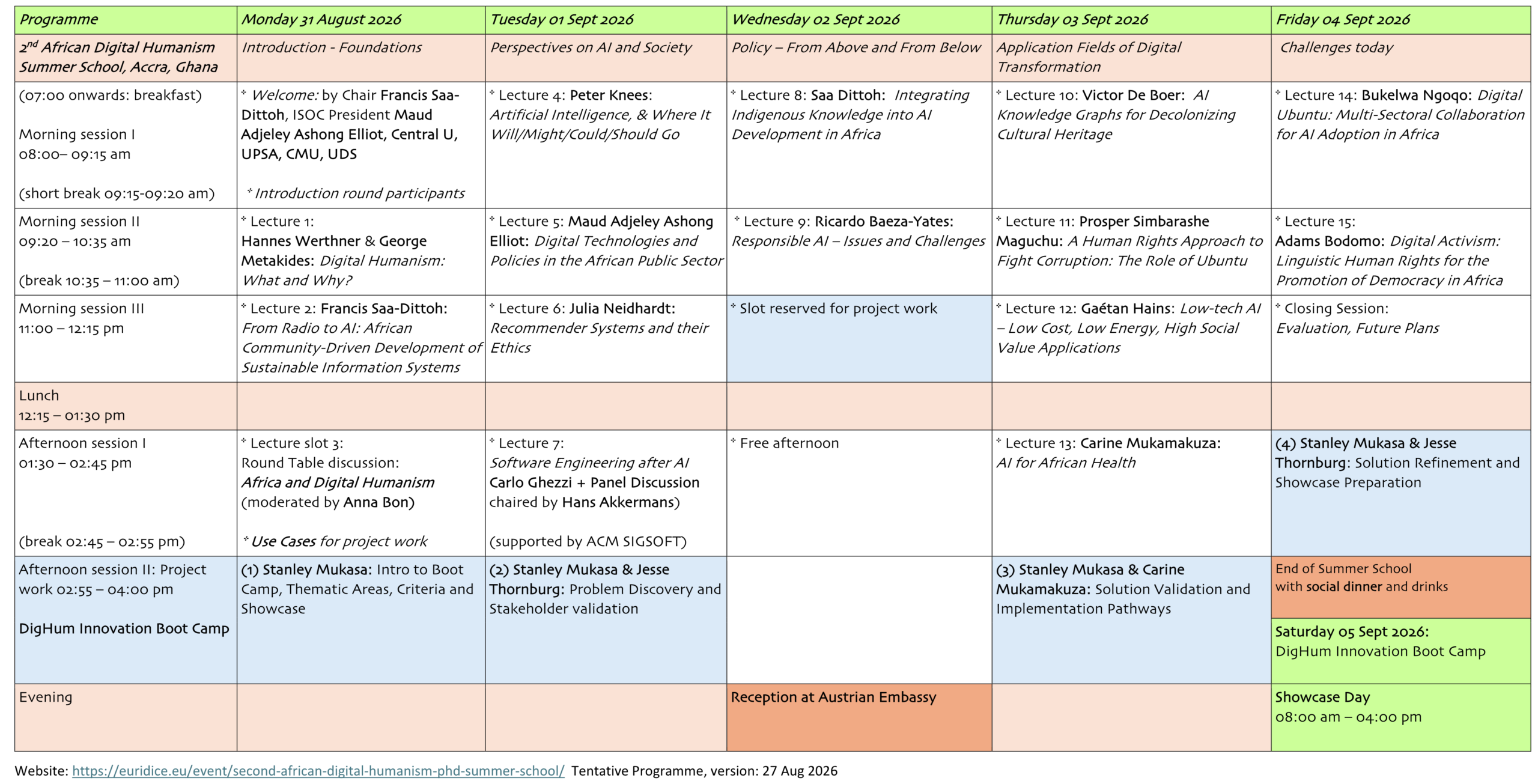
Tentative program of the week
Links to important pages:
We have compiled a reader with articles from all lecturers on the various themes of the Summer School. You can download the reader here:
Speakers: https://euridice.eu/speakers-at-the-second-african-digital-humanism-summer-school/
Organizing team: https://euridice.eu/organizers/
Questions can be sent by email to: [email protected]
Target Audience. The DigHum Summer School welcomes PhD students, postdocs and early career young staff, with a priority for participants from Africa. Participants from a variety of scientific disciplines are welcome. Participation presumes a strong interest in the socio-technical aspects of digital technologies and their applications in Society. This requires an interdisciplinary attitude and collaboration. We expect 50 up to 70 participants from various countries.In addition, on Saturday 05 September 2026 an innovation boot camp will be organized under the auspices of Carnegie-Mellon University CMU-Africa (Kigali, Rwanda).
Scholarships. A budget for fee waivers and financial support for qualified and motivated students and young researchers. The applications are now closed, as from 15th July. Decisions will be communicated.
Innovative Approaches. Several elements of the Summer School involve innovative ways of teaching and learning. The program as a whole (lecturers, topics, students) is unique in that it is thoroughly interdisciplinary and socio-technically oriented. Challenge-based collaborative project learning, with interactive mentoring by lecturers, is another key feature of the DigHum Summer School. Hands-on learning follow-up is enabled through the Innovation Boot Camp.
Experiential Learning. Students carry out a hands-on group project concerning a current challenge in the Digital Transformation. Results are presented by the students in a plenary, conference-style session at the end of the Summer School. On the Saturday after the Summer School an Innovation Boot Camp will be held. This enables to involve industry and create student interaction with practitioners. It also enables to bring further interesting results from the student group projects.
Diversity & Inclusion Considerations. From the start, Internet and Digital inclusiveness have been the prime reasons to organize a Digital Humanism Summer School specifically focused on Africa. A specific Africa-oriented event is valuable to make African voices better heard, acknowledge and address the specific African context and issues, help decolonize Internet and digital technologies, and so combat the Digital Divide, in ways that a general-audience Summer School cannot achieve. Along these lines, we contribute to strengthening socio-technical competences as well as collaborative networks of young Africans interested in digital technology and society. It is acknowledged (and borne out by experience) that young Africans do not have the financial means or support institutions to be able to bring up the costs and fees that typically go with international Summer Schools and conferences.
Visa invitation letters for non-Ghanaian participants can be requested when registering. We will support your visa application as much as we can. We recommend to apply for a visa as soon as possible.
This event falls under the patronage of:

The authors are responsible for the choice and presentation of views contained on this website and for opinions expressed therein, which are not necessarily those of UNESCO and do not commit UNESCO.
The Second Africa Digital Summer School is supported and made possible through generous contributions from various organizations: