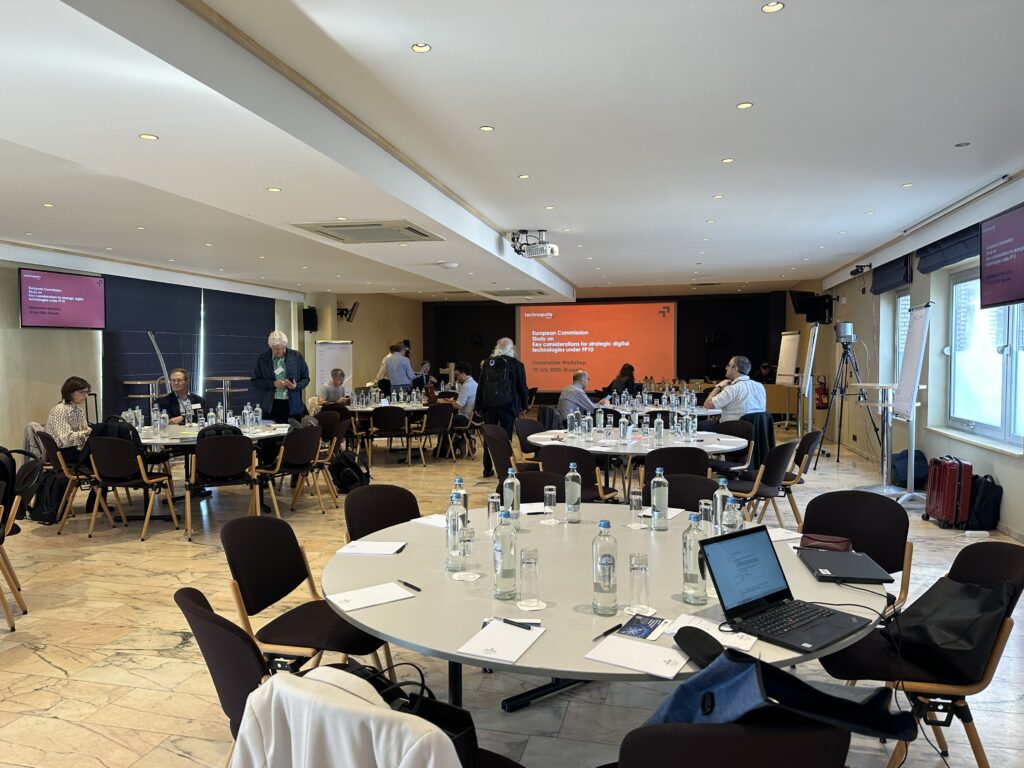
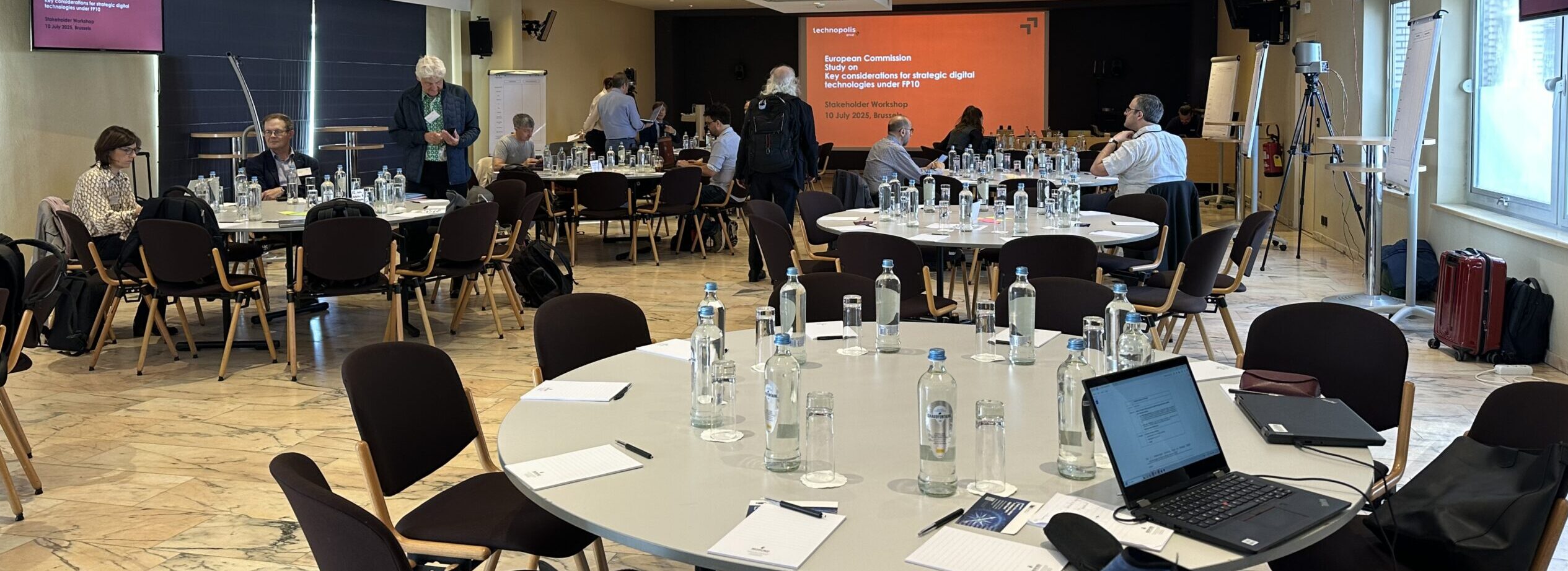
What are future trends in digital technologies to boost Europe’s digital economy and how can Europe catch up in areas where the US and China are currently leading the digital innovation. These and other topics were discussed in Brussels with some of Europe’s leading minds in digital technology from business, industry and academia. Over two intense days the European Commission’s DG CNECT gathered 75 experts to explore the future of Europe’s critical digital capacities beyond 2027. Representing EURIDICE, our small delegation joined this high-level consultation, to discuss the technical roadmaps for AI, robotics, quantum computing, and other strategic fields. And, most importantly, we brought to the table the human-centered perspective into a conversation often dominated by purely technological ambitions.
Brussels, 9 – 10 July 2025: A DG CNECT study was carried out on the Research & Innovation for the Strategic Digital Technologies for Europe’s Digital Decade. On behalf of EURIDICE a small delegation particiapted in this stakeholder consultation.
The first day consisted of a validation of arecent study on EU’s critical digital capacities deployment beyond 2027. A group of 75 technology experts from Europe’s business and academia were invited. We were seated around discussion tables, each table clustering experts around one of the key technologies. These were: Cloud & EdgeAI & Robotics, Semiconductors, Data Space, Photonics, Blockchain, Internet of Things, Quantum Computing, Next Generation Internet. In a World Cafe discussion setup, experts discussed specific questions on the given key technology and reported back in plenary. This was repeated several times, and followed by cross-technology discussions on each of the technologies. Our EURIDICE delegation choose the AI table., , AI & Robotics, Semiconductors, Data Space, Photonics, Blockchain, Internet of Things, Quantum Computing, Next Generation Internet. In a World Cafe discussion setup, experts discussed specific questions on the given key technology and reported back in plenary. This was repeated several times, and followed by cross-technology discussions on each of the technologies. Our EURIDICE delegation, given our expertise and project focus, was seated at the table for AI experts. The participants represented mainly large ICT companies or industries with high stakes in digitization, robotics, such as the media & culture and food & bio industries.
The first day, after a keynote by Matthieu Delescluse, Acting Head of Unit, European Commission DG CNECT, we discussed strengths & weaknesses of the current European ecosystem focused on the digital capability for deployment. After lunch we discussed future investment strategies for the EU in the next decade – which activities should be funded? Interesting for EURIDICE was the EU strategy on digital infrastructural needs, skills, ecosystem capabilities. We dissussed requirements for a next EU programme for digital technology deployment.
The second workshop day was on Research & Innovation, maturity levels, how to select the highest promise for transformative market applications. This stakeholder consultation will feed the information needed for the design of the requirements of the next European Framework Programme (Multilateral Financial Framework MFF).
Our EURIDICE’s, Digital Humanism inspired, human-centered orientation towards digital technology innovation contributed specifically to the discussion on the requirements for AI innovation. We brought to the table the need for ethics by design requirement that must be formulated for any AI-research and innovation project be it call or large scale programme. Our input was welcomed and made into the plenary and EU reporting. Another important point of our critique was the conceptualization of innovation from a purely techncal perspective, as alinear process, detached from its societal need and impact.
However, it was deceptive to see that ethics and society, despite being acknowledged at the table the moment they were mentioned, would not have been highlighted if the EURIDICE team would not have participated.