
Can we improve digital skills of teachers and learners in a hybrid way? The answer to this question is at the heart of the Collaboratorium, EURIDICE’s famous innovation for teaching and learning in a hybrid, interconnected European setting. The Collaboratorium will soon start, as the Master Digital Society, Social Innovation and Global Citizenship will start its first classes, simulataneously at the University of Naples, the University of Innsbruck and Palacky University in Olomouc. To enrich the experience of teaching, EURIDICE developed, in close collaboration with the Imaginary Institute, a toolbox and methodology. This is being used and implemented in real cases by various innovators.
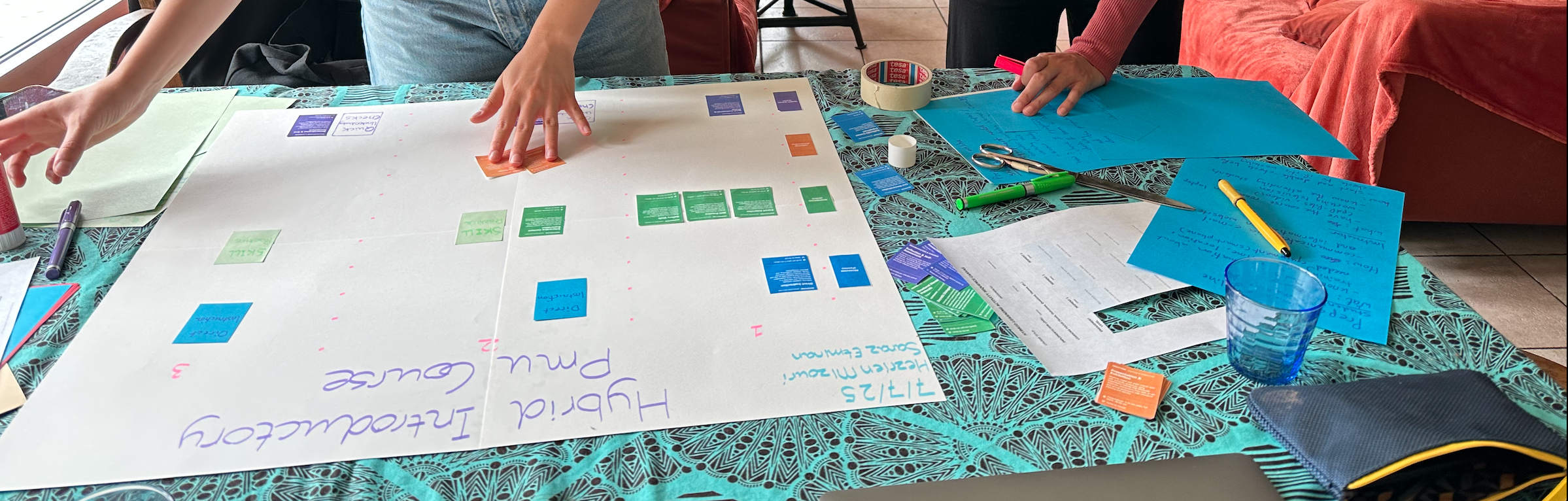
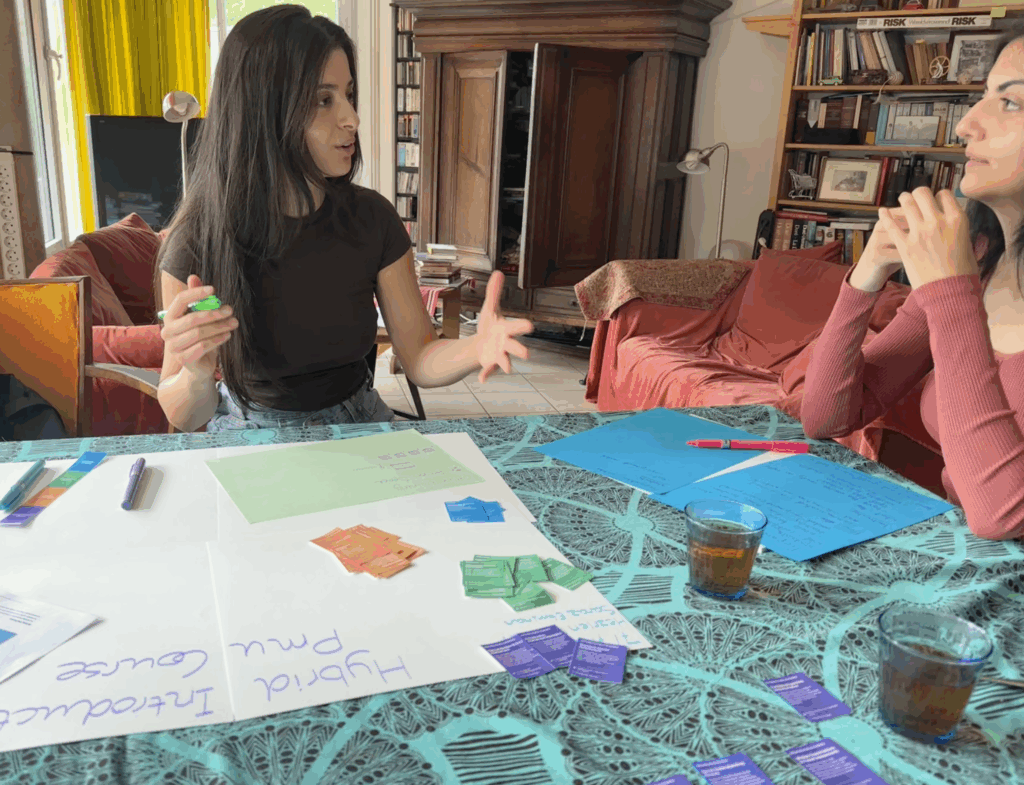
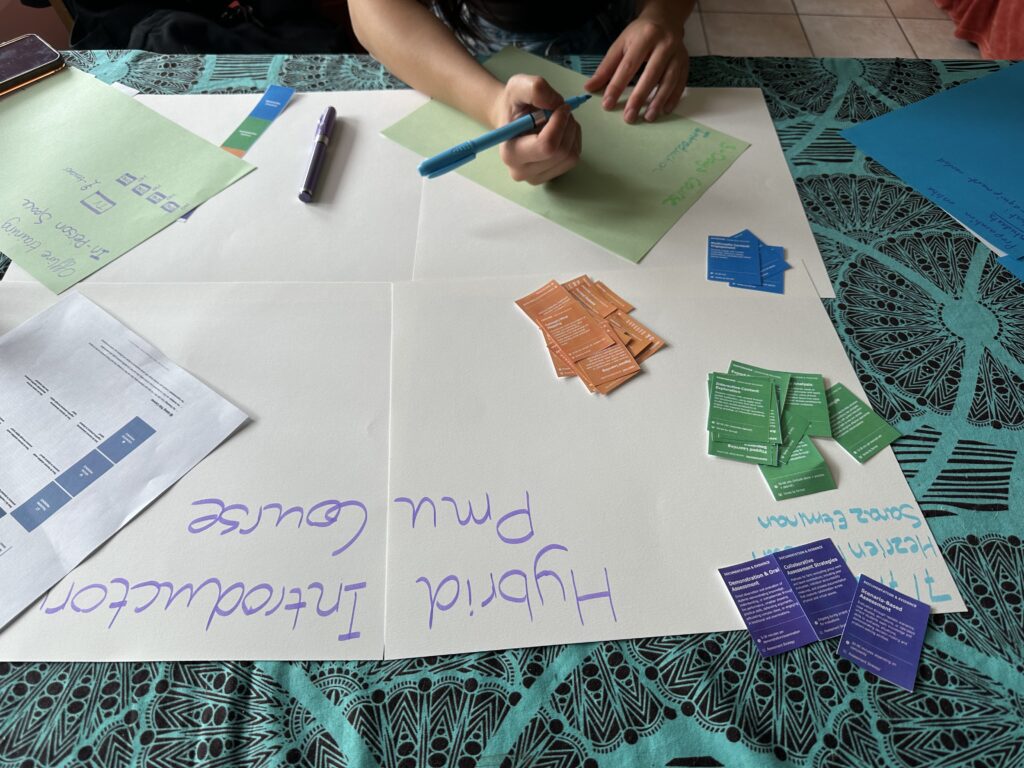
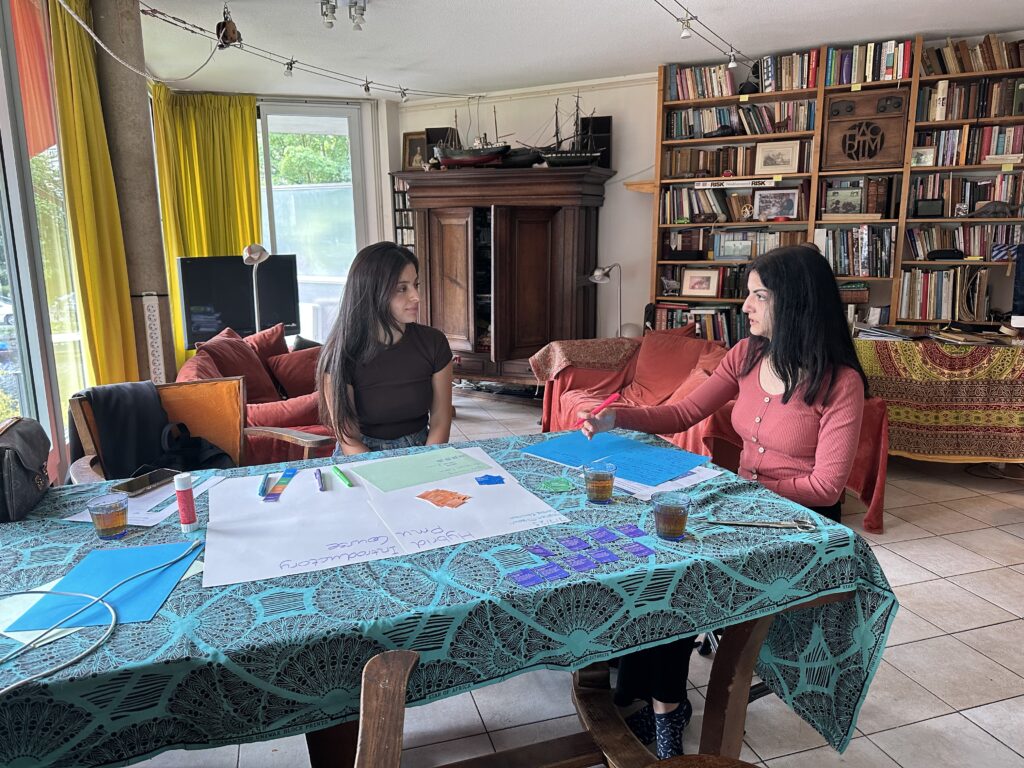
Sanaz Etiminian and Hezrien Mizouri are two of these entrepreneurial, young innovators. They are currently at the final stages of their Master’s research project in Information Sciences. Their project focuses on designing and implementing hybrid and virtual learning methods for professional education. The initiative is not solely academic; their final goal is to apply the new approach in a professional training context. Sanaz, who is, besides student also young entrepreneur, aims to use the new approach to enhance the company of which she is the CEO. But first she wants to complete her Master’s and write her thesis on this topic of digital education, in close collaboration with her colleague student Hezrien. For this project Sanaz and Hezrien are exploring EURIDICE’s new methodology and design toolkit. The toolbox and methodology were developed by the Imaginary Institute in close collaboration with the Department of Social Sciences at Università degli studi di Napoli Federico II.
The Hybrid Learning Design Toolkit used in this workshop was created to teach EURIDICE’s lecturers how to design and implement hybrid education, one of teh core innovations of EURIDICE’s master DigiSoc. The complete design work was carried out within the framework of EURIDICE. The first batch of teachers was trained during five full online sessions in July 2025. There were 18 online and on-site participants, of which 7 women and 11 men.
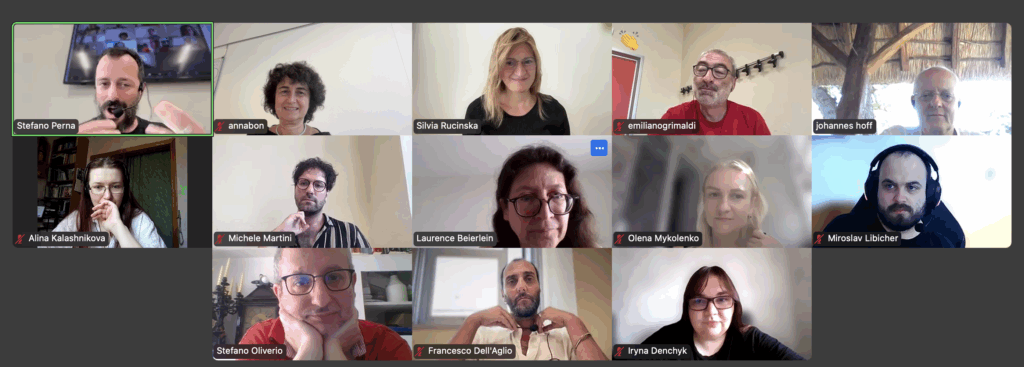
Figure 2: A group of academic lecturers from various partner institutions of the EURIDICE project engaged in the “hybrid hybrid learning design” course.
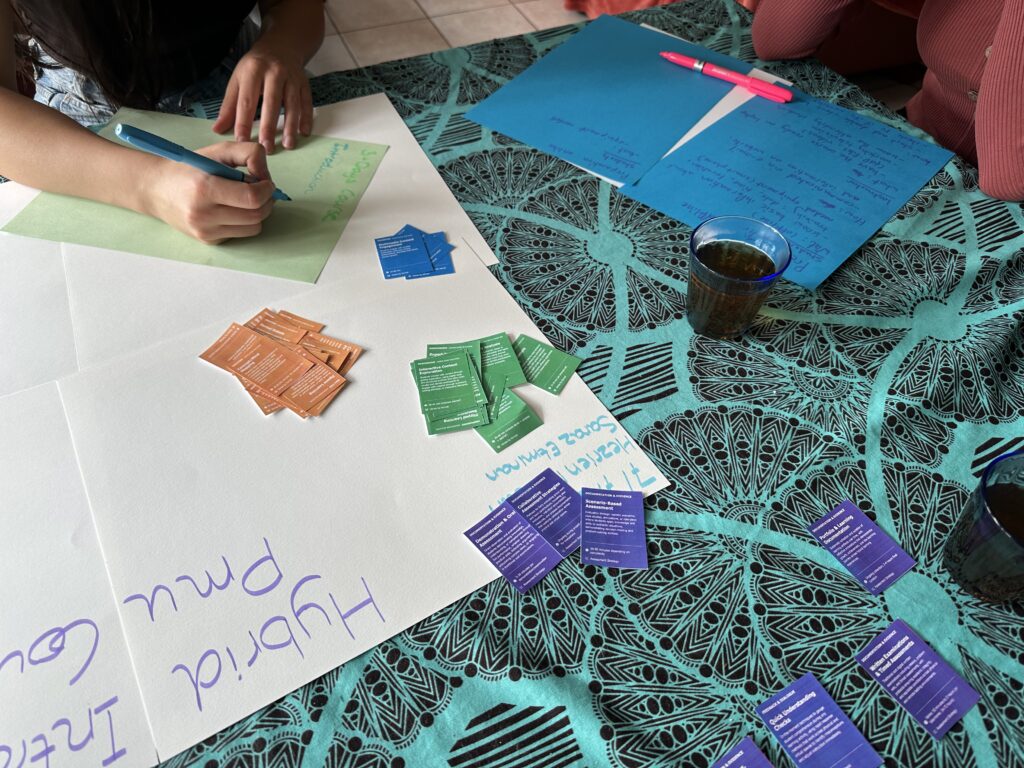
During this teacher training, participants were introduced to tools like Miro for remote group collaboration. Meanwhile Sanaz and Hezrien, who worked in parallel in the same period, while being physically in Amsterdam, worked together in an in-presence space. The toolbox proved highly effective, also for the master project’s purposes. The design cards were printed and arranged on a paper canvas. The complete method facilitated a productive and structured discussion around course design.
As explained by Stefano Perna, workshop facilitator, trainer and design expert from the Imaginary Institute, this innovative approach draws on a holistic and experimental pedagogy structured around three dimensions:
- Dimension 1: Environment and Technology – focuses on creating virtual spaces and integrating digital tools that function seamlessly together.
- Dimension 2: Learning Experience and Assessment – emphasizes the design of engaging learning activities that are accessible to students regardless of location.
- Dimension 3: Facilitation, Equity & Community – centers on building meaningful social connections among all participants, facilitators, and educators, across both physical and digital environments.
The design toolbox represents a significant innovation developed by EURIDICE within the framework of the Collaboratorium—the educational space where the European joint Master’s in Digital Society & Global Citizenship will be implemented by three European universities, with plans to expand and include additional academic partners.
The Hybrid Learning Design Toolbox is Open Source and can be used by any educator. It is published under Creative Commons Licence CC BY-SA 4.0. the full toolbox with an explanation and a full description can be used and downloaded from the open repository: https://imaginary-institute.github.io/hybrid-learning-design-toolkit/
As soon as the master thesis of Sanaz and Hezrien will be published, (due end of August 2025) it will be made available to the EURIDICE teaching community as a real world implementation and qualitative evaluation of this design methodology.
The master thesis by Sanaz Etminan and Hezrien Mizouri is here:
https://euridice.eu/wp-content/uploads/2025/09/Master_Research_Project_Etminan_Mizouri.pdf