
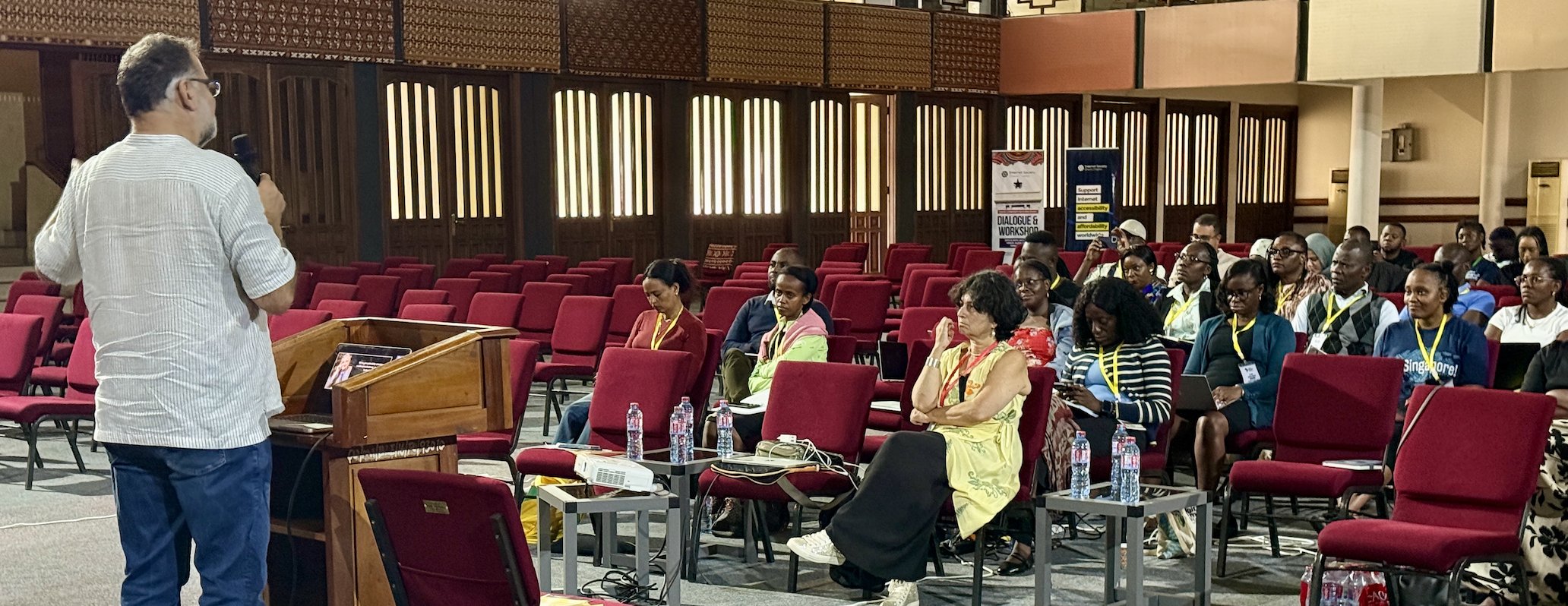
1 September 2026, A presentation plus panel discussion, entitled Software Engineering after AI was a remote/hybrid invited kick-off talk by Prof. Carlo Ghezzi (Politecnico di Milano, Italy), followed by an (onsite) panel discussion. Due to internet connectivity issues (not fully unexpected for those with some familiarity with the Digital Divide), we enacted Plan B, whereby Prof. Hannes Werthner (TU Wien, Austria) presented Carlo’s slides onsite.
In his talk, Carlo Ghezzi argued that software is the crucial technological component of our society today. The current state of (SE) research, education and practice is largely inadequate in view of this crucial role. SE is not a purely technical domain or “for technologists” anymore, we are all involved. Interdisciplinarity is needed to renew SE, but more broadly, interdisciplinarity is needed if we want to properly address the complexities of the digital world at large. A change of perspective is urgently needed to revisit how software is designed and how we educate designers. The Digital Humanism principles serve as a foundation here: technology must serve humans. Human values, rights, and dignity should be at the center of technological development. Technical knowledge is necessary but not sufficient. Transparency emerges as a main responsibility of designers. Designers must take responsibility for their designs, and we must make explicit the difficult questions and associated ethical thinking: is this good or bad? Right or wrong? Education must prepare the next generation of responsibleprofessionals. Academia is an ideal playground for interdisciplinary collaborations, and in-vitro experiments. Universities can play a fundamental role, but they need to preserve their freedom and reinforce their critical role, which is globally under threat.
Carlo’s talk was followed by a panel discussion. Panelists were: Prof. Hannes Werthner (TU Wien, Austria), Dr. Carine Pierrette Mukamakuza (Carnegie Mellon University Africa, Kigali, Rwanda), Prof. Gaetan Hains (Universite Paris-Est Creteil, France), Dr. William Mutero (director AfreTec African universities collaboration), and Dr. Anna Bon (VU Amsterdam, Netherlands). The panel was moderated by Prof. Hans Akkermans (Netherlands / University for Development Studies, Tamale, Ghana).
From the panel discussions several key impressions emerged. The call for a more interdisciplinary and diversity-oriented approach to SE in research, education and practice, in which ethics is an inherent part of the process in systems development, resonated strongly throughout the audience. It was noted, however, that the implementation of this is context-dependent. In the USA and Europe one may speak of a mature labourmarket in SE, but this is different in Africa. This also applies to AI. The billions of BigTech investments in AI are way beyond what Africa needs and can afford. Instead, Africa has to develop its own agenda, where working with (relatively) small-data, small-scale technologies and associated solutions (e.g. for the thousands of small languages spoken in Africa) offer much more urgency and promise than any BigTech“Big Bang” heavyweight AGI type solutions. Accordingly, the point of directly working in AI applications with the real on-the-ground stakeholders such as urban and rural African communities was repeatedly stressed.
This session was attended on 1 September 2026 by 70 participants.